Space Books for Kids, Fueling the Astronaut Phase
September 2, 2026 · 5 min read · by LittleVolumes
When a child falls in love with rockets and planets, books can turn the obsession into learning and a lifelong reading habit. Here is why kids adore space, the best types of space books by age, and how a personalized astronaut story puts your child on the moon.
Somewhere around age three or four, many children discover that above the ceiling there is a sky, and above the sky there is SPACE, with rockets and planets and a moon you can sometimes see in the daytime, and from that moment every conversation finds its way back to it. The astronaut phase is one of childhood's great intense interests, right beside dinosaurs, and it is a gift to any parent who wants to raise a reader. Handled well, a space obsession converts directly into books, vocabulary, counting, and the habit of learning for joy. Here is how to fuel it.
Why do children fall so hard for space?
Space hits the same psychological sweet spot as dinosaurs, with a bonus. It is enormous and powerful, which is thrilling for a person who is small. It is packed with learnable, listable things, eight planets, countdown numbers, rocket parts, which feeds the young brain's hunger for categories. And unlike dinosaurs, it is all still THERE, happening right now, with real rockets launching and a real moon out the window every night.
Developmental researchers call passions like this intense interests, and they are worth protecting: children with intense interests show stronger attention spans, better information-processing, and richer vocabulary. The child who can name the planets in order is running the exact cognitive machinery that later powers reading comprehension and science learning. The obsession is not a distraction from learning. It IS learning, arriving at maximum enthusiasm.
What kinds of space books work at each age?
| Age | What works | What to skip |
|---|---|---|
| 2 to 3 | Rocket countdown books, bold simple planet art, rhythm and repetition | Dense facts, realistic darkness |
| 3 to 5 | Story adventures with a child hero in space, friendly aliens and robots | Long texts, scary vastness |
| 5 to 8 | First fact books and atlases alongside stories, real astronaut tales | Books far below their obsession level |
The through-line at every age: the child should either see themselves in the story or get to be the expert. Space books that let a four year old shout "that is the MOON, it makes the tides!" earn their shelf space forever.
A note on tone: good space books for young children keep the cosmos friendly. The moon smiles, the stars twinkle warm, the rocket comes home for bedtime. The awe-and-void version of space has its time, around age eight, when kids start relishing the big numbers. Before that, cozy beats cosmic.
How does a personalized astronaut book change things?
There is one move that reliably turns a space-mad child into a book-mad child: put them inside the rocket.
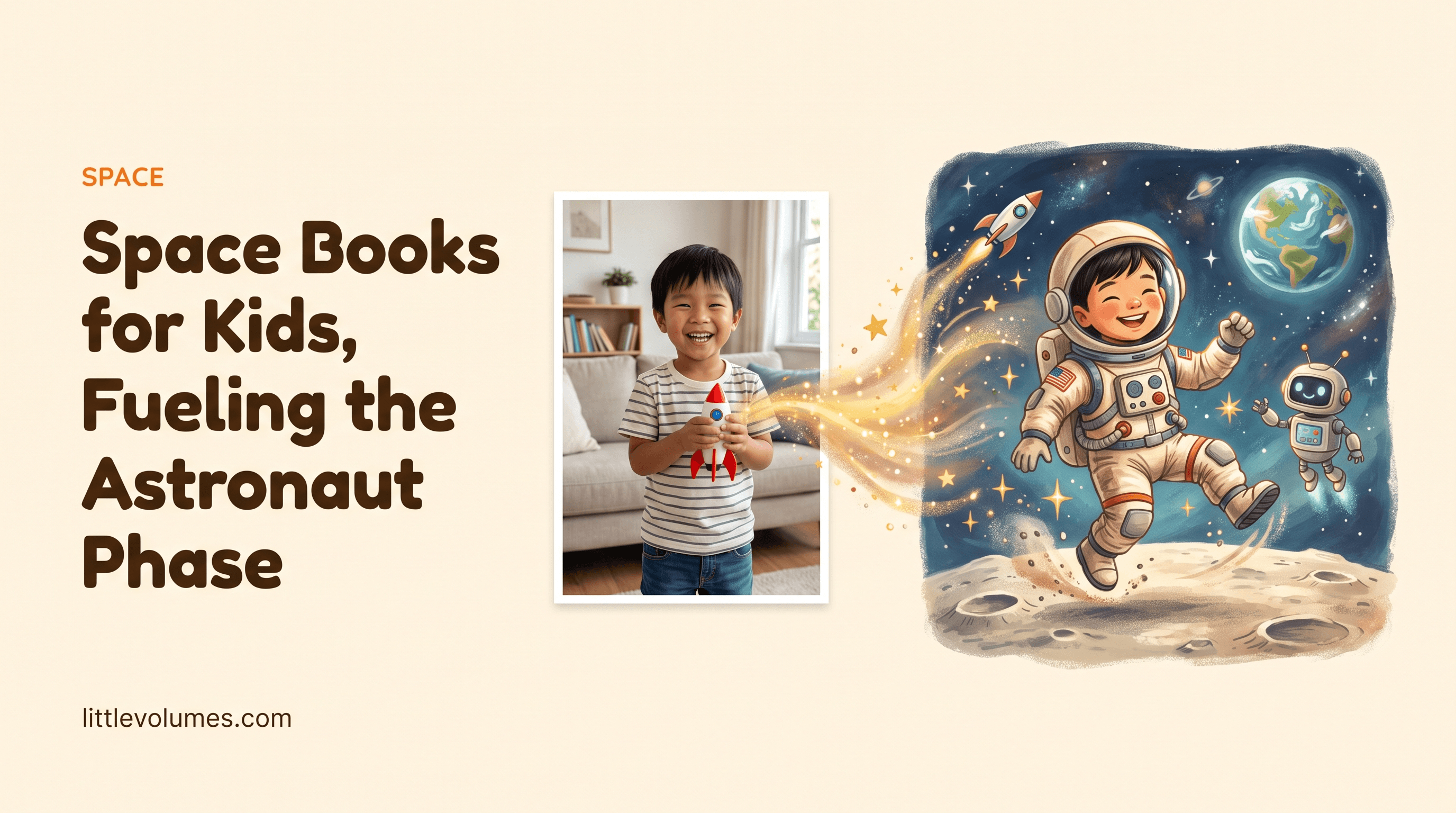
In our Astronaut book, your child IS the astronaut. A little robot lands in the garden with an emergency, the Moon has lost its glow, and only one brave child can bring it back. Your child suits up, counts down, blasts off, bounces across the moon in the bounciest jumps of all, finds the lost glow-stars, and comes home to bed under a moon that shines again because of them. Their face is in every illustration, drawn from photos you upload; their name is on the cover and in every line.
Why this works so well for this particular obsession:
- It fulfills the actual fantasy. A space-obsessed child does not want to read about an astronaut. They want to BE one. This is the closest thing to it that fits on a bookshelf.
- It converts obsession into reading habit. The book they request nightly is the reading practice that sticks. Personalized books reliably become that book, because caring what happens next is automatic when it happens to you.
- It survives the phase. When the space phase eventually hands over to the next obsession, the book remains, a keepsake of the year your child lived on the moon.
The digital book arrives within 24 hours, printed keepsakes ship worldwide, and the first page is free to preview, which for this particular book means seeing your own child in a spacesuit, a preview with a high grin rate.
What activities pair well with space books?
Books anchor the obsession; a little hands-on play multiplies it. The classics, all cheap or free:
- The real night sky. Five minutes of moon-gazing beats an hour of screens. Find the moon together on book nights; if the book's moon glows because your child fixed it, the real one gets very special indeed.
- Glow stars on the ceiling. The bedroom becomes space, and bedtime becomes re-entry.
- The cardboard rocket. A big box, a marker, twenty minutes. Countdown practice included, which is sneaky subtraction learning.
- Launch videos. Real rockets taking off, with the actual countdown, are electrifying for a preschooler and completely free.
- Moon-jump Olympics. Cushions on the floor, biggest slow-motion bounce wins. Gross motor development disguised as the moon.
Each one loops back to the book, and the book loops back to them. That interconnection, story to sky to play to story, is what turns a phase into a foundation.
The takeaway
The astronaut phase is not a detour on the way to learning; it is a launch window. Stock the shelf with space stories matched to their age, keep the cosmos cozy for now, follow the obsession rather than steering it, and give them the one book where the astronaut bouncing across the moon has their own face. Somewhere between the countdown and the glow-stars, a reader gets built. And decades from now, someone stepping off a ladder onto gray dust might remember exactly where this started.
Put your child on the moon: preview their astronaut book free, or explore the full catalog of personalized adventures.
Frequently asked questions
Why are kids so obsessed with space?
Space combines everything a young mind craves, enormous scale, real rockets and explosions, countable planets, and genuine mystery, all completely safe from the living room floor. Like dinosaurs, it is an intense interest that lets a small child feel big.
What are the best space books for a 4 year old?
At four, story beats facts. Look for picture books with a child protagonist on a space adventure, simple planet introductions with bold art, and countdown and rocket books with rhythm and repetition. Fact-dense encyclopedias land better from age six.
Are space books educational for preschoolers?
Very. Space books quietly build counting through countdowns, size and distance concepts, early physics intuitions like up, down and orbit, and a large vocabulary, rocket, planet, comet, astronaut, that preschoolers absorb with delight.
How do I encourage my child's interest in space?
Feed it across formats, books first, then the night sky itself, glow stars on the ceiling, cardboard-box rockets, and videos of real launches. Let them be the expert who teaches you. Interest-led learning at this age outperforms any curriculum.
Do personalized space books help reluctant readers?
Notably, yes. The hardest part of reading with a reluctant child is making them care what happens next. When the astronaut on the page is the child themselves, caring is automatic, and the book becomes the one they request.
What age is a personalized astronaut book for?
Roughly ages 3 to 8. Threes and fours love spotting themselves in the pictures, fives and sixes engage with the story arc, and early readers get a strong motivation boost from starring in the book they are learning to read.