How to Get a Dinosaur-Loving Kid Excited About Reading
August 10, 2026 · 6 min read · by LittleVolumes
If your child is obsessed with dinosaurs but not with books, use the obsession. Here is the research behind intense interests, practical steps that work, the best types of dinosaur books by age, and how a personalized dinosaur story turns a reluctant reader around.
If your child can pronounce Parasaurolophus but groans when you reach for a bedtime book, you are not failing at reading. You are sitting on a secret weapon and not using it yet. A dinosaur obsession is one of the most powerful reading tools a parent can have, and this guide shows you exactly how to use it: the research behind these obsessions, the practical steps that turn dino-love into book-love, what to look for at each age, and the one upgrade that changes everything for a reluctant reader.
Why are toddlers so obsessed with dinosaurs?
Dinosaurs hit a perfect psychological sweet spot for a small child. They are enormous, powerful and a little bit scary, which is thrilling. They are also extinct, which makes them completely, reliably safe. A three year old can command a T-Rex in their imagination and feel the power of something huge and wild without any real danger. For a person who is small in a world run by big people, that feeling is delicious.
Developmental researchers have a name for deep passions like this: intense interests. Studies suggest around a third of young children develop one, most commonly between ages 2 and 6, and dinosaurs and vehicles top the list. Far from being a quirk to redirect, intense interests are linked to measurably stronger attention spans, better information-processing, and more advanced vocabulary. A child who can name fifteen dinosaurs and sort them into meat-eaters and plant-eaters is running the exact cognitive machinery that later powers reading comprehension and scientific thinking.
In other words: the obsession is not competing with your child's education. It IS your child's education, arriving in its most enthusiastic form.
How do I turn the dinosaur obsession into a reading habit?
The core principle is simple: do not fight the interest, feed it. Every step below is a version of that.
- Let dinosaurs lead the library. Choose stories, picture books and characters built around dinosaurs rather than steering your child toward what you think is more balanced. Balance can come later. Habit comes first, and habit is built on wanting to open the book.
- Make your child the expert. Ask them which dinosaur is which. Get one wrong on purpose and let them correct you. When a child feels like the authority, books become a stage to shine on rather than a test to pass. This single move transforms reading time for many reluctant readers.
- Read little and often. Five happy minutes beats twenty tolerated ones. End while it is still fun. You are training the association "books feel good", and associations are built by how sessions end.
- Connect books to play. Read a page, then act it out with the toy dinosaurs. Build the volcano from cushions. When the story spills off the page into play, the book becomes the source of the fun rather than the interruption of it.
- Keep zero pressure on the reading itself. For ages 2 to 6, your only goal is that your child loves books. Letters, phonics and sight words ride in on the back of that love. They rarely survive without it.
What kind of dinosaur books work best at each age?
| Age | What works | What to avoid |
|---|---|---|
| 2 to 3 | Short picture books, friendly dinosaurs, repetition, chances to roar | Long text, realistic scary artwork |
| 3 to 5 | Story-driven adventures, humor, a child protagonist among dinosaurs | Dense fact pages, tiny illustrations |
| 5 to 8 | Fact books and encyclopedias alongside stories, early readers | Books far below their interest level |
The pattern across every age: the child should either see themselves in the story or get to feel like the expert. The books that gather dust are the ones that offer neither.
Why a personalized dinosaur book changes everything
There is one upgrade that reliably converts a book-avoider into a book-requester: put your child inside the dinosaur story.
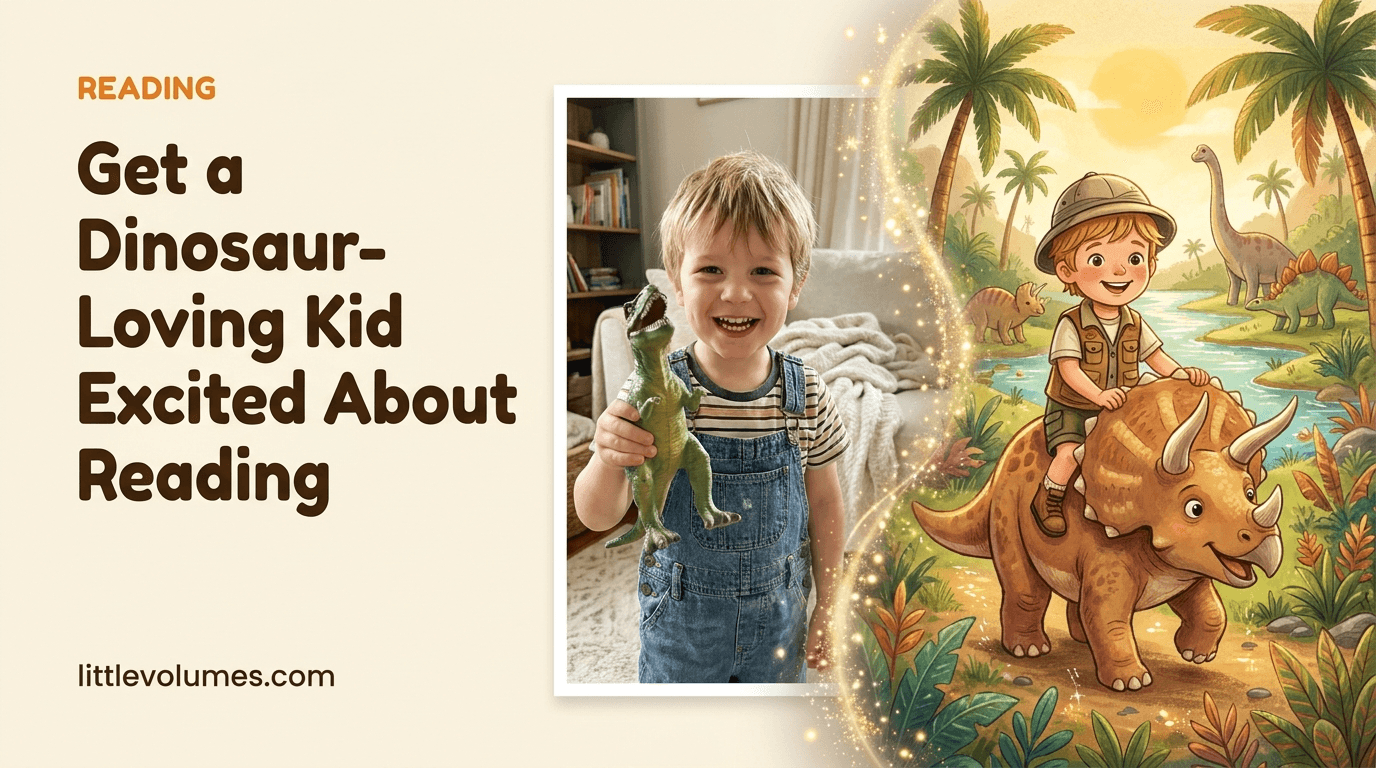
Research on personalized books has found that children pay attention longer, engage more deeply and remember more when they appear in the story themselves. The mechanism is obvious the moment you watch it happen. A reluctant reader's real problem is rarely the words. It is that they do not care what happens to the generic character. Make the hero your own child, with their name on the cover and their face in every illustration, and suddenly they care enormously. They want to turn the page to find out what THEY do next.
Now combine that with an intense interest. A personalized dinosaur adventure stacks the two most powerful engagement forces in early childhood on top of each other: this is about ME, and it is about DINOSAURS. Parents tell us it is the first book their dino-mad child asks for by name, night after night.
Our Dino Land book does exactly this. Your child becomes the brave explorer of a world full of friendly dinosaurs, illustrated from a few photos you share. The digital book arrives within 24 hours, and a printed keepsake can sit on the shelf long after the dinosaur phase has moved on. There is also a coloring book version where every scene comes once in color and once as line art to color in, which doubles as a rainy-afternoon activity.
What if my child only wants dinosaur books?
Let them. A child who reads twenty dinosaur books is practicing reading twenty times; a child pushed toward variety they did not choose often practices zero times. Range comes naturally later, usually through school and friendships. The habit you protect now is the one that makes that range possible.
If you want to stretch gently, stretch sideways rather than away: a book about a dinosaur going to school, a dinosaur learning about feelings, a dinosaur counting to ten. The dinosaur stays; new territory sneaks in alongside.
The takeaway
You do not need to talk your child out of the dinosaur phase to raise a reader. The obsession is the doorway, not the obstacle. Follow what lights them up, keep sessions short and joyful, hand them the expert role, and give them at least one book where the child riding the triceratops has their face and their name. One day the dinosaurs will quietly go extinct a second time, as all phases do. The reading habit they helped build will stay for life.
Ready to put your child in the middle of their own dinosaur adventure? Try it free and see the first page before you buy, or browse the full catalog of personalized books.
Frequently asked questions
Why are so many toddlers obsessed with dinosaurs?
Dinosaurs are big, powerful and a little scary, but completely safe because they are extinct. That mix lets a small child feel brave and in control. Researchers call deep passions like this intense interests, and roughly one in three young children develops one. They are a healthy sign of a focused, curious mind.
Are dinosaur obsessions good for child development?
Yes. Studies of intense interests link them to stronger attention spans, better information-processing skills and richer vocabulary. A child who can name fifteen dinosaurs is practicing exactly the memory and categorization skills that later power reading and science learning.
How do I get my reluctant reader interested in books?
Follow their interest instead of fighting it. Choose books on the topic they already love, keep sessions short and pressure-free, let them be the expert who teaches you, and connect books to play. Interest-driven reading consistently beats assigned reading for building the habit.
What are the best dinosaur books for a 3 year old?
At age 3, look for short picture books with big illustrations, simple repetitive text, friendly rather than frightening dinosaurs, and chances to roar along. Encyclopedic fact books work better from around age 5. A personalized dinosaur adventure where your child is the hero suits ages 2 to 8.
Do personalized books actually help reluctant readers?
Yes. Research on personalized stories shows children attend longer and engage more deeply when they are a character in the book. For a reluctant reader, being the hero removes the biggest barrier, which is caring about what happens next.
How long do dinosaur phases last?
Anywhere from a few months to several years, typically fading around ages 6 to 8 as school broadens a child's world. There is no need to rush it along. The focus and reading habits built during the phase outlast the dinosaurs themselves.