Screen-Free Activities for Toddlers That Actually Hold Attention
September 10, 2026 · 5 min read · by LittleVolumes
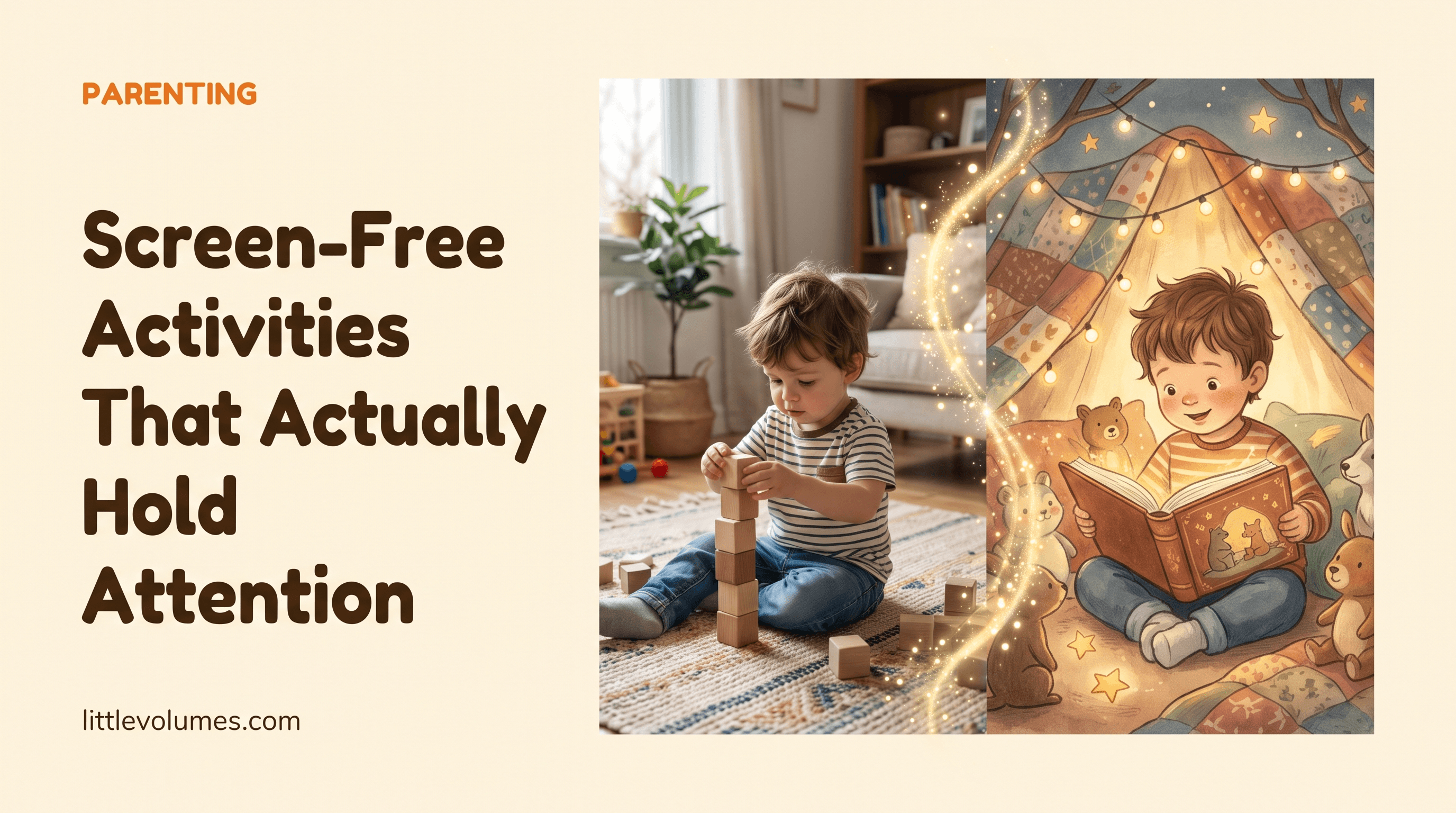
Cutting toddler screen time only works if something better fills the gap. Here are screen-free activities that genuinely hold toddler attention, why boredom is part of the plan, and how the right books become the strongest screen alternative in the house.
Every modern parent knows the guilty magic of the tablet: twenty minutes of peace, purchased instantly. And every modern parent has read the advice to cut toddler screen time, which is easy to agree with and hard to do at 5 pm on a rainy Tuesday. The missing piece in most screen-time advice is the replacement: what, exactly, is supposed to hold a two year old's attention instead? Here is the honest answer, the activities that genuinely work, the environment tricks that make them happen, and why the right books are the strongest screen alternative a family can own.
Why is screen time so hard to replace?
Because screens are engineered to be effortless. A video delivers color, motion, music and surprise with zero demand on the child. Self-driven play asks the toddler to generate the entertainment themselves, and that muscle, like any muscle, weakens when unused. The first days of reduced screen time therefore feel worse before they feel better: the child reaches for stimulation, finds effort instead, and protests.
The reassuring science: the adjustment is fast. Play researchers consistently observe that when screens recede and materials are available, toddler self-directed play rebounds within days. Boredom, the thing parents fear, is actually the mechanism, the itch that imagination scratches. The plan is not to fill every screen-shaped minute with parent-led entertainment. It is to set the stage and let the rebuilding happen.
What activities actually hold toddler attention?
Ranked by field-tested staying power:
| Activity | Setup | Why it holds |
|---|---|---|
| Water play | Sink, bowl, cups, towel down | Endlessly variable, sensory, self-driven |
| Chunky construction | Blocks, magnetic tiles | Can be anything, fails gracefully |
| Pretend props | Play kitchen, doctor kit, dress-up | Runs on imagination, not batteries |
| Real jobs | Washing veg, sorting socks, sweeping | Toddlers crave real contribution |
| Big-muscle play | Cushion course, dance, garden lap | Burns energy, regulates mood |
| Books they love | See below | The quiet superpower |
| Sensory bins | Rice, scoops, hidden toys | Deep focus, cheap refills |
Three environment tricks multiply all of them. Visibility: toddlers play with what they can see and reach, so open shelves beat toy boxes. Rotation: a small set of toys swapped weekly stays interesting; the full pile numbs. Boredom tolerance: when the I am bored moment comes, offer a material rather than a performance, here is the bowl and the cups, and hold your nerve for ninety seconds. That pause is where self-directed play begins.
Where do books fit in the screen-free day?
Books are the closest thing to a screen's job description, story, color, characters, escape, with the opposite developmental profile: language in, attention lengthened, lap time included. But every parent knows the catch: the book has to compete with the memory of the screen, and a generic book sometimes loses.
The evidence-backed fix is interest. Toddlers attend to what concerns THEM, their obsessions and, above everything, themselves. This is where a personalized book earns its place in a screen-time strategy: when the character on the page has the child's own face and name, attention stops being the parent's problem. Research on personalized stories finds children engage longer and more deeply, and parents report the practical version, it becomes the book the toddler brings to YOU. In the daily screen-free rotation, that book is the closer: the guaranteed engagement slot for the trickiest moments, the wind-down, the waiting room, the rainy 5 pm.
Pairing books to your child's current obsession stacks the effect, the dinosaur kid, the space kid, the truck kid, and a bedtime book starring the child anchors the evening routine, where screens do their worst damage to sleep. Every one can be previewed free with your child as the hero, which, fair warning, is a small screen-free activity in itself.
How do you actually cut down without a war?
The tactics that survive contact with real toddlers:
- Change the environment, not the child. Screens physically out of sight, remote out of reach, activities visible. Most toddler screen requests are triggered by seeing the screen.
- Warn before transitions. Two more minutes, then the tablet sleeps and we do water play. The bridge to a NAMED next thing matters, off is a void, the sink game is a plan.
- Keep a closer ritual. The same song as the screen goes off, then straight into the replacement. Ritual absorbs the protest.
- Protect the two danger zones. Meals and the last hour before bed are where screens cost most, digestion of family talk and melatonin respectively. Win those two and the rest is negotiation.
- Expect the three-day storm. Habit resets are loud, brief and worth it. By day five the requests drop sharply, the play muscle is back online.
- Use screens deliberately, not ambiently. A chosen show, watched together, discussed after, is a different product from background autoplay. The goal is less and better, not zero and miserable.
The takeaway
Screen-free toddlerhood is not built by removing something; it is built by making the alternative genuinely available: water and blocks in reach, jobs to help with, energy outlets, a small rotation that stays fresh, and books the child actually cares about, with the book starring the child themselves as the ace in the deck. Set the stage, tolerate ninety seconds of boredom, and watch the oldest entertainment system in the world, a small human imagination, boot back up. It was never broken. It was just out-shouted.
Give the screen some real competition: preview a book starring your toddler free, or browse the full catalog for their current obsession.
Frequently asked questions
How much screen time should a toddler have?
Major pediatric bodies recommend no screen time before 18 to 24 months except video calls, and no more than one hour daily of quality content for ages 2 to 5, ideally watched together. Most families land somewhere pragmatic, the goal is less and better, not perfection.
What can toddlers do instead of screens?
The reliable winners are water and sensory play, chunky construction, pretend play props, big-muscle activity, helping with real chores, and books, especially books the toddler is personally invested in. Rotating a small set beats owning a large one.
How do I reduce my toddler's screen time without meltdowns?
Change the environment rather than fighting each battle, screens out of sight, activities visible and reachable, warnings before transitions, and a replacement ritual ready. Expect a rough three to five days, toddler habits reset remarkably fast.
Why does my toddler get bored without screens?
Screens deliver effortless stimulation, so self-driven play feels slow at first. That gap is temporary and important, boredom is the on-ramp to imagination. Offer materials, not entertainment, and within days the play muscle rebuilds.
Do books really compete with screens for toddlers?
They can, if the child cares about the book. Interactive reading, letting them turn pages and predict, helps, and personalized books where the toddler is the story's hero reliably out-compete generic books because self-interest is the strongest attention hook there is.
What is a good screen-free bedtime routine?
Screens off at least an hour before bed, then a fixed sequence, bath, pajamas, teeth, two books, song, lights out. The story slot is the anchor, a beloved book, ideally one starring the child, pulls the whole routine along.