Pirate Books for Kids and the Power of Adventure Play
September 3, 2026 · 5 min read · by LittleVolumes
Treasure maps, parrots and a big red X. Pirate stories are a staple of childhood for good reasons. Here is what adventure play does for development, how to pick pirate books that are exciting but not scary, and the personalized pirate story that makes your child the captain.
Hand a four year old a cardboard tube and within a minute it is a telescope, there is a ship, and you have been conscripted as crew. Pirate play is one of childhood's most durable games, and pirate books are its fuel. Behind the eyepatches and the squawking parrots, adventure stories are doing serious developmental work: rehearsing bravery, teaching maps and sequences, and building the kind of reader who cannot wait to find out what is behind the X. Here is how to choose pirate books that thrill without scaring, and how to make the game even better.
Why do children love pirates so much?
Count the ingredients: a boat of your own, a map with a secret, treasure, an animal who talks, special clothes, and nobody telling you to tidy your cabin. Piracy, as children imagine it, is simply childhood with better props and full autonomy. The historical unpleasantness does not exist in this world, and it should not; kid piracy is about freedom and discovery, not crime.
There is also a deeper pull. Psychologists who study pretend play note that children use role-play to try on power. A small person who is steered through their whole day, dressed, buckled, scheduled, gets to be the CAPTAIN, the one who reads the map, gives the orders and braves the dark cave. That rehearsal of agency is not a distraction from development. It is development, wearing a bandana.
What does adventure play actually teach?
More than it appears from the outside:
- Courage rehearsal. Facing the dark cave in a story, then in a cushion-fort game, is how children practice being brave at zero stakes. The feeling of I was scared and did it anyway transfers to real life remarkably well.
- Maps, sequence and space. Following first the palms, then the cave, then the X is early spatial and sequential thinking, the same muscles behind math and reading comprehension.
- Persistence. Adventures are structured as setback, setback, triumph. Children absorb narrative patterns as expectations for life: keep going, the treasure comes.
- Language by the shipload. Anchor, compass, crow's nest, ahoy. Themed vocabulary sticks because it is charged with play value.
- Social play scripts. A shared story gives a crew of kids a common script, which is precisely what group pretend play needs to run for an hour instead of five minutes.
How do you pick pirate books that are exciting but not scary?
For the 3 to 7 crowd, the line between thrilling and frightening matters. What to look for:
| Look for | Skip for now |
|---|---|
| A child captain and a friendly crew | Villain pirates with weapons |
| Gentle stakes, find the treasure, brave the dark | Battles, walking the plank as threat |
| Animal sidekicks with personality | Skull imagery played for menace |
| Warm resolution, shared treasure, sunset party | Cliffhangers before bed |
| Humor throughout | Realistic peril |
The excellent news is that gentle does not mean boring. A dark cave that turns out to be full of glittering crystals delivers the full bravery arc with zero nightmares. Stakes scale beautifully at this age: to a four year old, digging where the X is IS high drama.
What makes a personalized pirate book special?
Pirate play always stars the child; most pirate books do not. Closing that gap is exactly what a personalized version does.
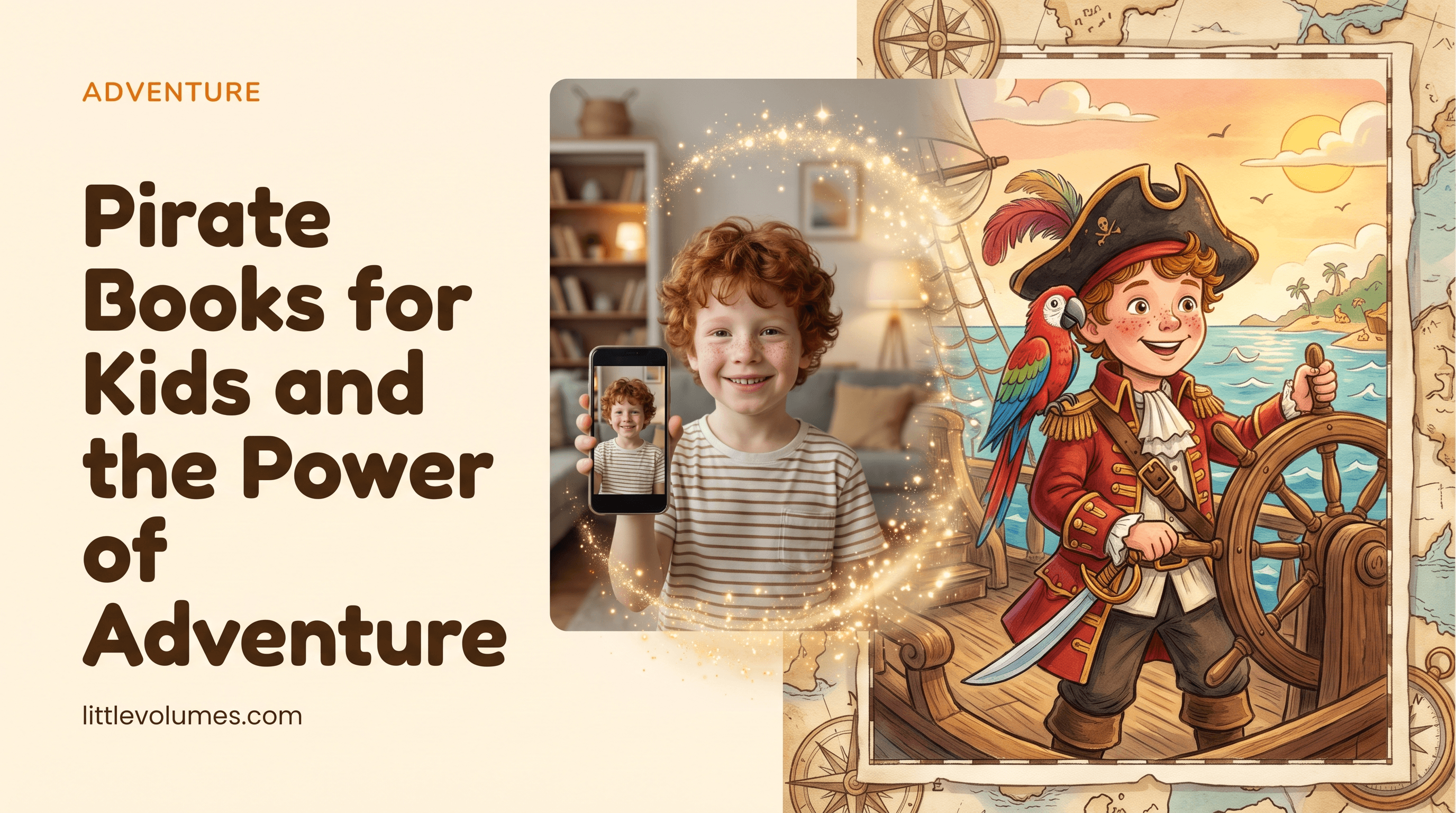
In our Captain book, the map in the bottle washes up at your child's feet, with their name on the captain's orders. They take the wheel of the good ship Starfish, with Salty the parrot in the crow's nest. They follow the three palms, brave the whispering cave, discover it is lined with crystal stars, dig at the X, and lift the lid on the gold, and a note addressed to the bravest captain on the seven seas, who is, of course, them. Their face, drawn from your photos, captains every page. And the ending lands the right lesson gently: gold is nice, but a crew of friends is the best treasure of all.
What parents report matches what the research on personalized stories predicts: attention lasts longer, the book gets requested more, and the story leaks gloriously into play. The book becomes the script; the sofa becomes the Starfish; bedtime negotiations begin to include the phrase aye aye.
The first page previews free, the digital book arrives within 24 hours, and the printed keepsake stands up to being read aboard many cushion ships.
How do you extend the book into play?
Pirate books practically beg to leave the page. The high-yield moves:
- Draw a real treasure map. Of the living room, the garden, the park. Five landmarks, a dotted path, an X, and something actually hidden there, a snack works wonders. Map-reading practice disguised as glory.
- Build the ship. Sofa cushions, a broom mast, a tea-towel flag. Let the book's scenes script the voyage.
- Commission the props. An old key becomes THE key. A shoebox becomes the chest. Objects borrowed from a story carry ten times the play value.
- Talk like a pirate at dinner. Vocabulary practice, morale boost, and the funniest fifteen minutes of the week.
- Read, then sail. The tightest loop: story at breakfast, voyage before lunch. Story-fed play runs deeper, and play-fed reading requests come nightly.
The takeaway
Pirate stories endure because they hand children the thing they want most, command of their own adventure, in a package of maps, parrots and gold. Choose the friendly-crew versions, let the stakes stay gentle, and turn the pages into play at every opportunity. And if you want to see the whole thing catch fire, give the captaincy to its rightful owner: the book where the brave soul at the wheel has your child's face and name. Anchors up.
Make your child the captain: preview their pirate book free, or chart a course through the full catalog of personalized adventures.
Frequently asked questions
Why do kids love pirate stories?
Pirates combine everything appealing to a young imagination, boats, maps, treasure, animal sidekicks, dressing up and mild rule-breaking, all in a world where the child can be the captain. Adventure at a safe distance is exactly how children like their excitement.
Are pirate stories too scary for young children?
They do not have to be. For ages 3 to 7, look for friendly-crew pirates, gentle stakes like finding treasure rather than fighting, and warm endings. Skip skull-heavy villainy until a child is older and asks for it.
What do children learn from adventure stories?
Adventure stories let children rehearse courage, problem-solving and persistence at a safe distance. Following a treasure map builds sequencing and spatial thinking, and a hero who keeps going after setbacks models resilience in a form kids actually absorb.
What age are pirate books best for?
The golden window is about 3 to 7, peak pretend-play years. Threes enjoy the props and sounds, fives are deep in role-play and maps, and sevens graduate to longer pirate chapter books.
Is there a personalized pirate book?
Yes. LittleVolumes makes Captain {name} and the Treasure Map, where your child is the illustrated captain, with their name and face throughout, a parrot first mate, a crab guide and a treasure hunt with a warm twist. It is made from photos with a free preview.
How can I extend pirate play beyond books?
Draw treasure maps of your home or garden and hide real finds, build a cushion ship, practice tying simple knots, and let the book's story script the game. Story-fed pretend play runs deeper and longer than play without a narrative.