Fun Ways to Teach Toddlers to Count With Books They Love
August 12, 2026 · 6 min read · by LittleVolumes
Teaching a toddler to count works best through play and stories, not drills. Here is when children actually learn numbers, the everyday games that build number sense, what makes a great counting book, and why a personalized one gets toddlers counting along.
Teaching a toddler to count does not require flashcards, worksheets or a single tense moment at the kitchen table. The children who arrive at school confident with numbers almost always got there the same way: through songs, games, fingers, snacks and stories, repeated joyfully hundreds of times. This guide covers what number learning actually looks like under the surface, the everyday habits that build it, what makes a counting book genuinely effective, and how a personalized counting book turns a toddler from audience into participant.
When do toddlers actually learn to count?
Counting looks like one skill but is really a stack of them, arriving in a reliable order:
| Stage | What it looks like | Typical age |
|---|---|---|
| Reciting | Says "one two three" like a song, may skip numbers | 2 to 3 |
| One-to-one counting | Points at objects, one number word each | 3 to 4 |
| Cardinality | Knows the last number counted is how many there are | Around 4 |
| Comparing | Knows five is more than two without recounting | 4 to 5 |
| Numeral recognition | Connects the squiggle 3 to three things | 3 to 5 |
Two things about this table matter more than the ages in it. First, the ranges are wide, and normal covers far more ground than parents fear. Second, the stages cannot be skipped or rushed by drilling. A child who can chant to twenty but cannot hand you three crackers has a party trick, not number sense. The goal of everything below is the understanding underneath the chant.
What everyday games teach counting best?
The strongest research finding in early math is almost comically reassuring: ordinary life, narrated with numbers, is the best curriculum available. The moves that matter:
- Count real, touchable things. Stairs while climbing, grapes onto the plate, ducks at the pond, buttons up the coat. Physical objects plus spoken numbers is the connection that abstract counting later stands on.
- Emphasize the total. After counting three cars, say "Three cars!" with delight. That little recap is how the cardinality principle, the biggest single leap in early math, gets installed.
- Sing the songs. Five Little Ducks and friends automate the number sequence for free, and subtraction sneaks in the back door as ducks go missing.
- Talk in quantities. "Two more spoonfuls." "One for you, one for me." "You have four blocks and I have two, you have more!" Comparison words, more, fewer, same, are math words.
- Use fingers freely. Finger counting is not a crutch. It is the body's built-in number line, and research links early finger use to later arithmetic skill.
- Keep it under two minutes. Number moments should be sprinkled through the day, not scheduled. The dose is tiny; the frequency is everything.
Notice what is missing: drills, corrections and tests. If a child says "one, two, five", the winning response is to keep cheerfully counting correctly yourself in daily life. They self-correct from exposure, not from being stopped.
What makes a great counting book for toddlers?
Counting books work because they put the three faces of a number, the spoken word, the written numeral and the actual quantity, on the same warm page. The good ones share a few traits:
- Countable illustrations. Big, distinct objects a small finger can land on one at a time. If you cannot easily point-count the items, neither can your child.
- One to ten, not one to a hundred. Depth beats range at this age.
- A story, not a list. Numbers attached to a narrative stick better than numbers in sequence, because memory loves meaning.
- An invitation to join in. Books that ask the child to find, point and count convert reading from a show into a game.
- Charm enough to survive fifty readings. Repetition is the mechanism. The book has to be one everyone can stand to repeat.
Read them interactively: point together, count out loud together, pause before the total and let your child supply it. That pause is a tiny engine of cardinality.
Why a personalized counting book gets toddlers counting along
Everything in early math runs on one scarce resource: a toddler's attention. And nothing on earth holds a toddler's attention like themselves.
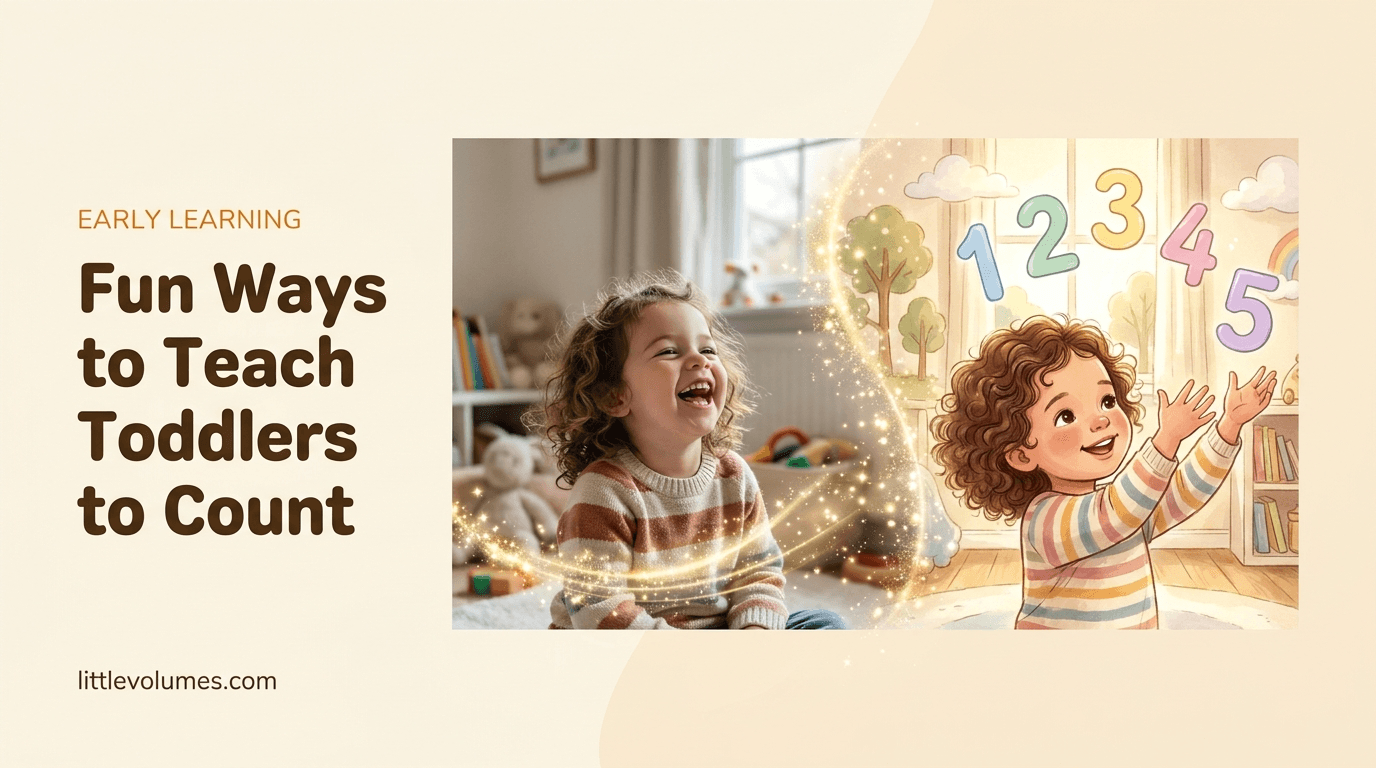
A personalized counting book makes your child the star of the count. They are not watching a generic character count someone else's shoes; they are counting THEIR morning, THEIR red shoes, THEIR sleepy toes, with their own face in every illustration and their name on the cover. The effect on engagement is immediate and visible: children lean in, point at themselves, shout the numbers, and ask for the book again tomorrow. Which is precisely the repeated, delighted exposure that builds number sense.
There is a second, quieter benefit. A child who stars in a book about counting starts to see themselves as someone who counts. Early academic identity, I am a kid who is good at numbers, forms astonishingly early, and it forms from evidence like this.
Our Counts to Ten book turns your child into the star of a gentle counting journey through their own day, one sun to ten sleepy toes, illustrated from a few photos you share. The digital book arrives within 24 hours, and the printed keepsake stands up to the many re-reads this one collects. Math practice that feels, to everyone involved, like a bedtime story.
What should I avoid when teaching numbers?
A short list, because the mistakes matter less than parents fear, but a few are worth dodging:
- Flashcard drills. They teach the squiggle without the meaning and can attach performance anxiety to numbers years early.
- Correcting every error. "One, two, five" fixes itself with exposure. Interruption teaches only that counting invites criticism.
- Testing on demand. "Count to ten for grandma!" turns a game into a performance. Let them show off only when they volunteer.
- Comparing to other children. The ranges are wide and the finish order predicts almost nothing.
- Worrying at age 2 or 3. If by age 5 a child shows no interest in counting and cannot count small sets, mention it to a teacher or pediatrician. Before then, play on.
The takeaway
You do not teach a toddler to count so much as you soak them in numbers until counting grows. Count the stairs, sing the ducks, narrate the snacks, read the books, and celebrate the totals. Keep every bit of it warm and pressure-free, and give them at least one book where the child doing the counting is unmistakably, delightedly them. The math comes. And it comes attached to the belief that numbers are friendly, which is worth more than any head start.
Make your child the star of their own counting book: try it free and see the first page before you buy, or explore the full catalog of personalized learning books.
Frequently asked questions
At what age should a toddler be able to count to 10?
Most children can recite numbers to 10 somewhere between ages 2 and 4, but reciting is different from understanding. Truly counting objects with one-to-one correspondence usually develops between 3 and 4, and grasping that the last number counted is the total, the cardinality principle, typically clicks around age 4. Wide variation is completely normal.
How do I teach my 2 year old numbers?
Through daily life, not lessons. Count stairs as you climb, snacks onto the plate, toys into the basket. Sing counting songs, read counting books, and use number words in ordinary talk, two shoes, three ducks. At 2, exposure and fun are the entire curriculum.
What is number sense in early childhood?
Number sense is the intuitive feel for what numbers mean, that five is more than two, that adding one makes more, that the last number counted tells you how many. It is built through hands-on experience and predicts later math success better than early memorization does.
Are counting books effective for teaching math?
Yes. Shared reading of counting books links number words, numerals and quantities on the same page, which is exactly the connection early math depends on. Books also add story and emotion, which help memory. The effect is strongest when you point, count together and connect numbers to things your child can touch.
Should I use flashcards to teach my toddler numbers?
Skip them at this age. Flashcards teach recognition without meaning and can turn numbers into a performance test. Counting real objects and reading counting books builds the same recognition plus the understanding underneath it, with none of the pressure.
How does a personalized counting book help?
Attention is the whole game with toddlers, and nothing holds a toddler's attention like themselves. When your child stars in the counting story, counting their own toes and toys through their own day, they lean in, count along and ask for the book again, which is exactly the repetition early math needs.