Raising Kind Kids, What Actually Works Before Age Eight
September 11, 2026 · 5 min read · by LittleVolumes
Kindness is built, not born, and the early years are the construction window. Here is what research says about how empathy develops, the daily habits that grow it, the mistakes that backfire, and how stories where your child is the kind hero do heavy lifting.
Every parent has a private ranking of hopes, and somewhere above grades and trophies sits the big one: please let this child be KIND. The good news from developmental science is that kindness is less like eye color and more like language, children are born with the wiring, and the environment decides how fluently they speak it. The early years are the construction window. Here is what actually grows kindness in children under eight, the well-intentioned mistakes that backfire, and why the stories a child stars in do some of the heaviest lifting.
Where does kindness actually come from?
Empathy has visible roots almost from the start: babies cry at other babies' crying, and toddlers under two will pat a sad adult or fetch their comfort object for someone else, an astonishing act of perspective-taking for a person who cannot yet use a fork. But the full apparatus, understanding what another person feels, caring about it, and knowing what to do, assembles slowly across the first seven or so years.
Three inputs do most of the building:
- Modeling. Children photocopy the adults they love. The parent who thanks the cashier warmly, helps the neighbor, speaks gently about others, is running the most effective kindness curriculum in existence, silently.
- Practice. Kindness is a motor skill as much as a feeling. Children need real reps, helping, comforting, sharing, giving, not because they are made to, but because the household runs that way.
- Stories. Narrative is empathy's gym. Following a character, feeling WITH them, wanting things to turn out well for them, is perspective-taking practice at zero social risk, and research consistently links rich story exposure to stronger empathy in children.
Notice what is absent: lectures. Explaining kindness to a four year old has roughly the effect of explaining swimming. The water does the teaching.
What daily habits grow kind kids?
The high-yield habits, none of which take extra time so much as extra intention:
- Narrate kindness when you see it. Did you see how that boy helped his sister up? Children learn what to notice, and noticing kindness everywhere teaches that it is everywhere expected.
- Praise identity, not transactions. You are such a helper beats good job sharing. Studies find identity praise, being asked to BE a helper rather than TO help, measurably increases helping, children live up to nouns.
- Give real jobs with real stakes. Carrying the mail, feeding the cat, delivering the neighbor's parcel. Contribution is kindness practice with proof attached: my help matters.
- Run the repair routine. When unkindness happens, and it will, daily, skip the forced sorry and run repair instead: name the impact, ask what could help, support the fix. Children learn more kindness from repairing one real hurt than from a hundred extracted apologies.
- Keep a gratitude beat. One good thing at dinner, one thank-you noticed. Gratitude and kindness share wiring; exercising either strengthens both.
- Guard the basics. Tired, hungry children have no kindness budget, neither do tired, hungry parents. Sleep and snacks are moral infrastructure.
And the one habit to drop: paying for kindness. The classic research finding is that material rewards crowd out internal motives, children rewarded for helping help LESS later, once the payment stops. Warm noticing, yes. Sticker economies for compassion, no.
How do stories build kindness, and what makes the effect stronger?
When a child follows a story, they are doing something socially miraculous: living inside someone else's experience. Feeling the character's worry, wanting their rescue, relaxing at their relief. That is perspective-taking, the cognitive half of empathy, being exercised page after page. It is why children who marinate in stories consistently test stronger on empathy measures, and why the BOOKS a family reads are quietly part of its moral curriculum.
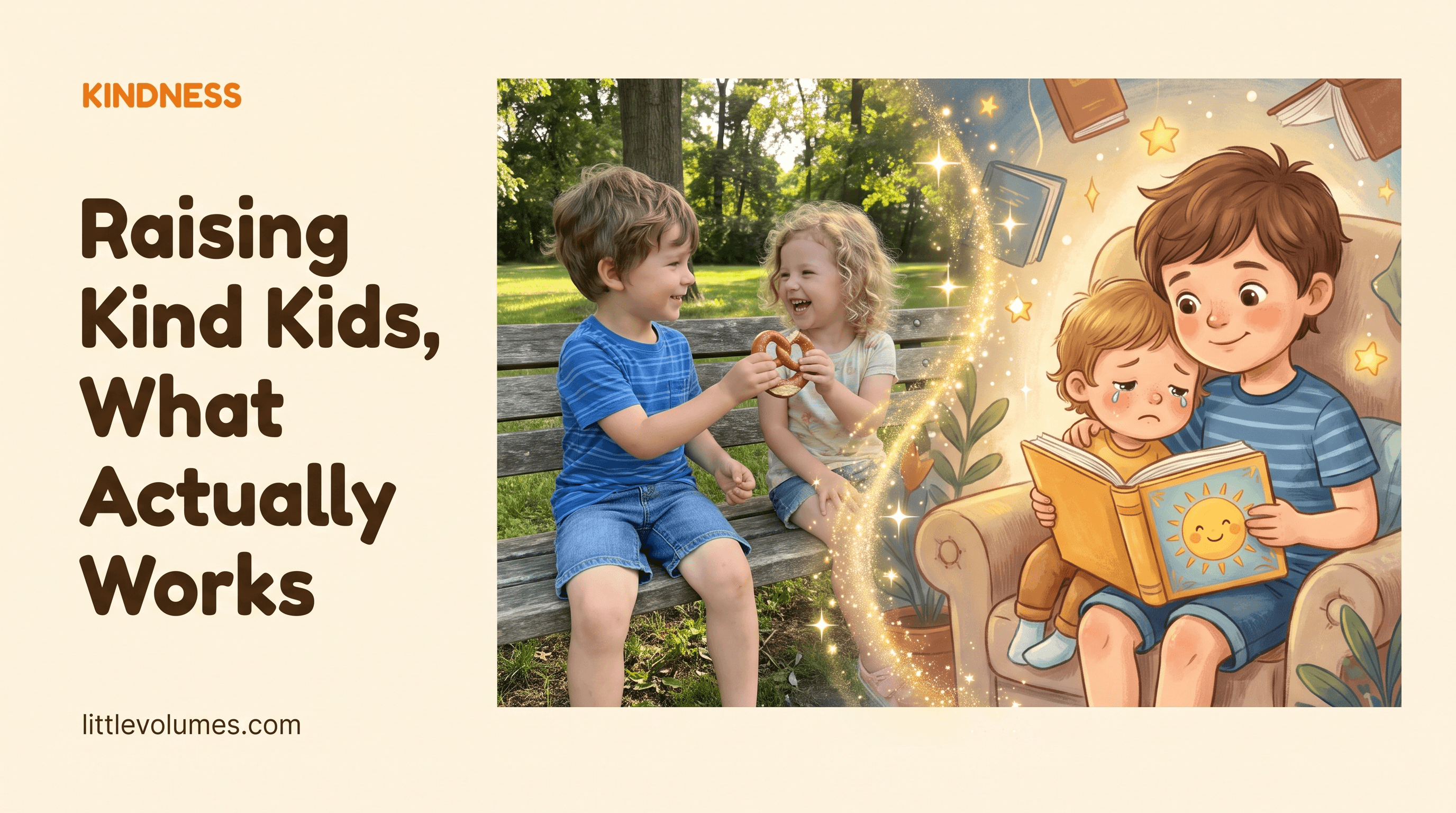
Two selection rules sharpen the effect. First, choose stories where kindness is the engine of the plot, not a garnish: the hero wins BY kindness, the lonely character gets included, the gentle act saves the day. Second, and this is where personalization earns its place in a kindness strategy, let the child BE that hero.
The difference is identity. A child watching a character be kind learns kindness is good. A child seeing THEMSELVES, their face, their name, be the one who listens to the sad boy on the swings, who befriends the lonely octopus instead of scolding him, who shares the scarf in the snowstorm, collects printed evidence about who they are. Our books are built around exactly these moments deliberately: the superhero whose real power is kindness, the reef adventure resolved by befriending the lonely, the big sibling who becomes the baby's gentle protector, the feelings book that makes every emotion okay. Read nightly by a child who stars in them, they are not entertainment with a moral. They are identity, installing.
What about when kindness fails?
It will, spectacularly, often in public. The snatched toy, the shove, the brutal toddler honesty about someone's hat. None of it predicts an unkind adult; it predicts a child, whose empathy hardware is still in assembly. What matters is the response: calm, impact named, repair invited, warmth maintained. A child whose unkind moments are met with contempt learns to hide harm; one whose moments are met with repair learns to fix it. The second child grows into the adult you are hoping for.
And when the child is unkind to YOU at home while being an angel at school, take the strange comfort veteran teachers offer: children spend their best self-control abroad and bring the leftovers home, because home is where they are safe. It is exhausting, and it is a compliment.
The takeaway
Kindness in children is built from copied behavior, real practice, warm noticing and a thousand stories, laid down in the years when identity is soft. Model it without commentary, hand them real ways to help, praise who they are becoming rather than what they just did, repair rather than punish the failures, and stack the bookshelf with stories where goodness wins, including the ones where the good one is unmistakably, illustratedly them. Raise the evidence, and the verdict follows: I am someone who helps. Everything else grows from there.
Give your child the starring role in kindness: preview a book free, or browse the full catalog of stories where they are the hero.
Frequently asked questions
At what age do children develop empathy?
The roots appear startlingly early, toddlers show comforting behavior before age two, but full perspective-taking builds gradually to around age seven and beyond. The early years are the construction window, which is why daily modeling and stories matter so much then.
How do I teach my child to be kind?
Model it visibly, narrate it when you see it, give the child real chances to help, praise the identity rather than the act, you are such a helper, and feed them stories where kindness is the hero's power. Teaching by lecture works far less than all of the above.
Why is my kid kind at school but not at home?
Usually a good sign, children spend their best self-control abroad and release the day's tension where they feel safest. Keep home expectations warm and consistent, protect rest, and treat home lapses as fatigue rather than character.
Do books really make children kinder?
Yes, measurably. Story characters let children practice perspective-taking, feeling with someone unlike themselves, and research links rich story exposure to stronger empathy. Stories where the child themselves is the kind hero add identity, I am someone who helps.
Should I reward my child for being kind?
Sparingly. Material rewards can crowd out the internal motive, the classic finding is that paid helpers help less later. Warm noticing and identity praise, that was so kind of you, you really are a helper, strengthens kindness without buying it.
What is the best way to handle unkind behavior?
Calmly, with repair. Name the impact, her tower broke and she is sad, invite the repair, what could help her feel better?, and skip forced apologies in favor of real ones. Children learn kindness from how their unkind moments are handled.