Books That Help Toddlers Understand Their Big Feelings
August 11, 2026 · 6 min read · by LittleVolumes
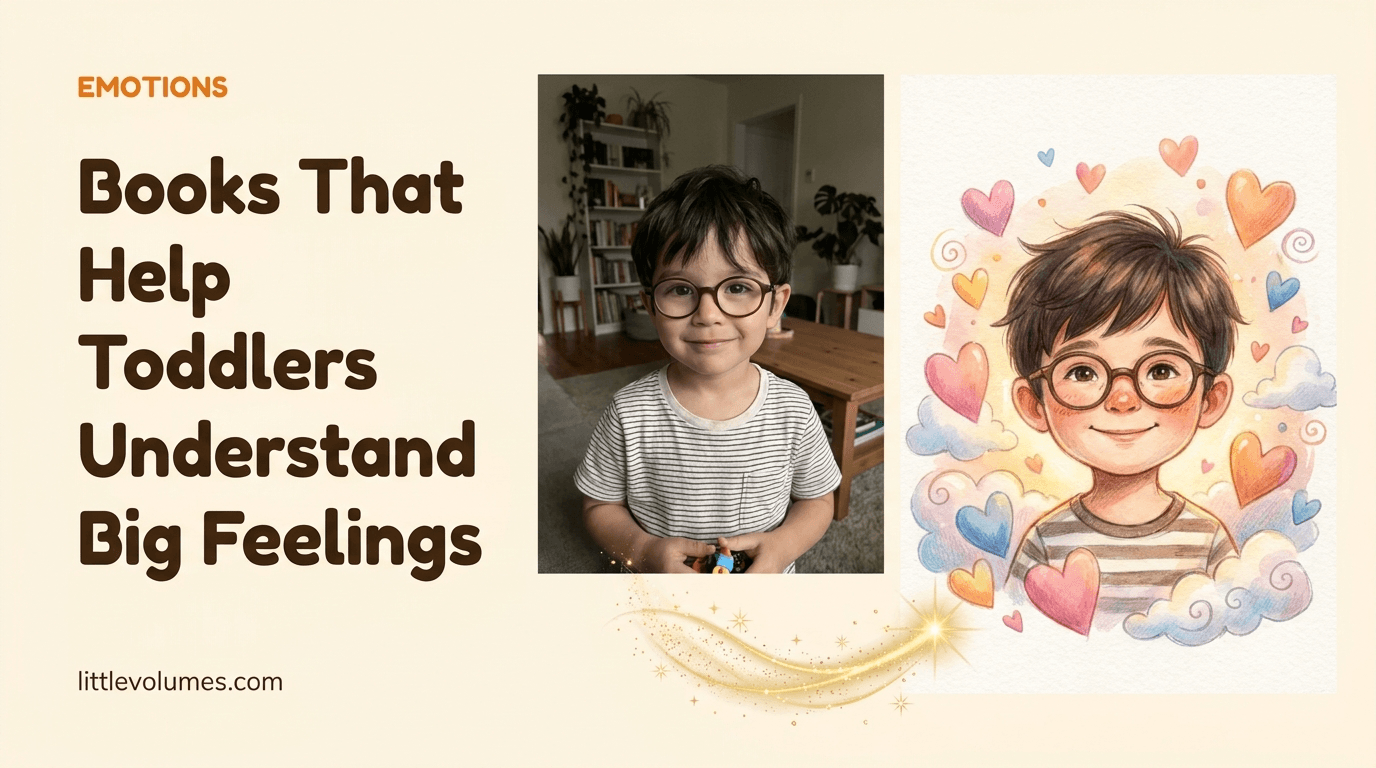
Toddlers feel huge emotions with no words for them yet. The right books give feelings a name and show a child that every feeling is okay. Here is the science of name it to tame it, what to look for in emotion books, how to read them well, and why a personalized version lands deepest.
A toddler mid-meltdown over a broken banana is not being dramatic on purpose. They are experiencing an emotion the size of a weather system with no words for it, no context that it will pass, and a brain whose calming machinery is years from finished. Books about big feelings are one of the gentlest, most effective tools parents have for this stage. This guide explains why they work, how to choose good ones, how to read them so they actually help, and why a personalized feelings book reaches a child in a way no generic book can.
Why do toddlers have such big feelings?
A young child's emotions are genuinely enormous, and the part of the brain responsible for managing them, the prefrontal cortex, is still decades from fully built. Emotion arrives at full strength; regulation arrives on a very long delay. That gap IS toddlerhood.
So a lost toy, a change of plan, or the wrong color cup can trigger a response that looks wildly out of proportion to an adult. To the child, it is perfectly proportioned: they feel exactly that much, and they lack every tool an adult uses to shrink a feeling, including the most basic one, a name for it.
This is why "calm down" does not work on a two year old. It is an instruction to use equipment they do not own yet. What they need instead is help building the equipment, and that is where books come in.
How does naming a feeling actually calm a child?
Psychologists call it affect labeling, and the finding is one of the most robust in emotion research: putting a feeling into words reduces the intensity of the feeling. Brain imaging studies show that labeling an emotion dampens activity in the amygdala, the brain's alarm system, and engages the prefrontal regions that manage responses. Dr. Dan Siegel gave parents the memorable version: name it to tame it.
For a toddler, the sequence looks like this:
- They feel something huge and formless.
- Over many calm, repeated exposures, they learn the huge formless thing has a name: frustrated, disappointed, jealous, scared.
- Once it has a name, it has edges. A named feeling is a thing they HAVE rather than a thing they ARE.
- A child who can say "I am so frustrated" has already stepped out of the storm far enough to say so, and is far less likely to hit, bite or scream it instead.
A good feelings book runs this exact sequence on every page, in the safest possible setting: someone else's storm, observed from a warm lap, with a parent's voice attached.
What should you look for in a book about feelings?
The genre is crowded and quality varies enormously. Look for these five things:
- Simple, honest naming. The book should say the words angry, sad, scared, jealous, plainly, not dance around them.
- All feelings treated as acceptable. The message that matters is every feeling is okay, every action is not. Avoid books that rank feelings into good ones and bad ones.
- A character the child can identify with, moving through ordinary moments: a fallen tower, a taken toy, a goodbye at daycare.
- The feeling passing. The single most reassuring fact about emotions, and the one toddlers least believe mid-storm, is that they end. The book should show the arc: feeling arrives, feeling is felt, feeling passes, child is fine.
- A calm tone, not a lecture. The best books feel like comfort, not curriculum.
One thing to actively avoid: books that rush the character to cheer up. A story that sprints from sad to happy in one page turn teaches that sadness needs fixing fast, which is the opposite of the lesson.
How to read feelings books so they actually work
| Do | Because |
|---|---|
| Read during calm, cozy moments | Skills are built in calm and used in storms, never learned mid-storm |
| Pause and connect: "Have you ever felt like that?" | Links the story to their real experience |
| Use the book's language later: "You are frustrated, like in your book" | The story becomes a shared shorthand |
| Re-read as often as they ask | Repetition is how toddlers install anything |
| Let them linger on one page | The page they stare at is the one doing the work |
The mid-tantrum moment is for co-regulation: your calm presence, few words, safety. The book's moment is the quiet afternoon and the bedtime wind-down, when the learning machinery is actually open.
Why a personalized feelings book lands deepest
Here is what takes a feelings book from useful to genuinely powerful. When the child in the story is your own child, the lesson changes category. A generic book says: children have big feelings and that is okay. A personalized book says: YOU have big feelings and YOU are okay.
For emotional learning, that difference is everything, because the whole point is self-acceptance. A child seeing their own face beside the words "some days are wobbly, and that is okay" receives the message the way it is meant: not as information about children in general, but as truth about themselves. Parents tell us these books become requested reading precisely on the hard days, which is the system working: the child is reaching for the story that tells them they are alright.
Our Big Feelings book puts your child at the heart of a gentle story that names every big feeling, sunshine days and wobbly ones alike, and shows them each one is okay. It is illustrated from a few photos you share, arrives digitally within 24 hours, and is available as a printed keepsake sturdy enough for the many, many re-reads this one tends to get.
What else helps alongside the books?
Books are one tool in a small kit. The others, briefly:
- Your calm is contagious. Co-regulation precedes self-regulation by years. The calmest nervous system in the room sets the ceiling.
- Predictable routines shrink the number of surprises a small person has to absorb in a day.
- Naming in the moment, briefly and without a lecture: "That is disappointment. It really hurts." Then quiet company.
- Catching the good ones too. Name joy, excitement and pride as enthusiastically as the hard feelings, so the vocabulary is complete.
The takeaway
You cannot spare your child from big feelings, and you would not want to; feelings are how a rich life registers. What you can do is hand them, years early, the tools that make feelings survivable: names, the knowledge that they pass, and the certainty that they are loved in every emotional weather. A warm book does that quietly every time you read it. A book where they are the hero does it while looking them in the eye.
Give your child a story about their own big feelings: try it free and see the first page before you buy, or browse the full catalog of personalized books for every stage.
Frequently asked questions
What are big feelings books?
Picture books that help young children recognize and name emotions like anger, sadness, worry, jealousy and joy. They typically follow a character through a feeling from start to finish and show that the feeling is normal, manageable and temporary.
At what age should I start reading emotion books to my child?
From around age 2, when strong feelings arrive well before the words for them. Children who build an early feelings vocabulary tend to manage emotions better through the preschool years, so earlier is genuinely better.
How does naming a feeling help a toddler calm down?
Naming an emotion engages the thinking part of the brain and measurably lowers the intensity of the emotional response. Researchers call this affect labeling, and Dr. Dan Siegel popularized it for parents as name it to tame it. A book that names feelings out loud hands your child that tool.
How do I teach my toddler emotional regulation?
Model calm during their storms, name feelings as they happen, keep routines predictable, and read books about emotions during calm moments rather than mid-tantrum. Regulation is a skill built slowly through thousands of small, safe repetitions, not a lesson learned once.
Are tantrums normal in toddlers?
Completely. The brain systems that manage strong emotion are among the last to mature, continuing into the mid twenties. A toddler tantrum is not bad behavior or bad parenting. It is a nervous system doing exactly what a two year old nervous system does, and it responds best to calm, connection and time.
Why use a personalized book about feelings?
When the child in the story who feels angry, sad and worried, and is okay, is YOUR child with their own face and name, the message lands as self-belief rather than information. It tells them directly that all of their feelings are acceptable, which is the foundation of emotional health.