Preparing Your Toddler for a New Sibling, What Actually Helps
August 15, 2026 · 6 min read · by LittleVolumes
A new baby changes your toddler's whole world. Here is how to tell them, when to start preparing, what regression is normal, how to protect the first meeting, and why a big sibling book starring your toddler works so well.
A new baby is wonderful news for everyone in the house except, at least initially, the person whose world it turns upside down: your toddler. From their point of view, an adored rival is moving in permanently, and nobody asked them. How you prepare them in the months before makes a real difference to how the first weeks go, and to the sibling relationship that follows. This guide covers when and how to tell them, what preparation actually works, the regression almost every family sees, the first meeting, and the single most effective tool we know for turning dread into pride.
When and how should you tell your toddler?
For most families, the second trimester is the sweet spot: early enough that they hear it from you rather than sensing something is up, late enough that the wait is not endless. A toddler's sense of time is foggy, so skip dates entirely and anchor to their calendar: when it gets cold, after your birthday, when the leaves fall.
Keep the announcement itself low-key and repeatable. This is not one conversation but hundreds of tiny ones: talking to the bump at dinner, wondering aloud together what the baby will look like, feeling kicks. Casual, frequent references normalize the baby long before arrival.
Two framing habits pay off enormously later:
- Make changes early and blame nothing on the baby. If the toddler is moving rooms or beds, do it months ahead, framed as a big kid upgrade. Changes that happen at the baby's arrival, in the baby's name, breed resentment with a return address.
- Talk about the baby as theirs too. "Your baby sister." "When our baby comes." Ownership language plants the team feeling you are hoping for.
What preparation actually helps a toddler adjust?
The goal of the preparation months is simple to state: make the abstract concrete, and make the new role attractive. What works:
- Read big sibling books, often. Stories are how toddlers rehearse the future. A book that walks through the arrival, the crying, the visitors, the mixed feelings and the proud moments gives your child a map of what is coming. More on the strongest version of this below.
- Give them jobs now. Helping set up the crib, choosing an outfit for the baby's first day, packing the hospital bag's "big sibling snacks". Contribution converts a bystander into a stakeholder.
- Practice on a doll. Gentle hands, quiet voices near sleeping babies, how to hold. Toddlers learn by doing, and the doll takes the learning curve so the baby does not have to.
- Visit a real baby if you can. Ten minutes around a friend's newborn teaches more about crying, feeding and smallness than a month of explanations.
- Keep their world steady. The fewer simultaneous changes, the more capacity your toddler has for the one big one. Guard naps, meals and rituals fiercely in the final months.
What should you expect after the baby arrives?
Regression, probably. A previously potty-trained child having accidents, a good sleeper waking, requests for the abandoned dummy or bottle. This is among the most predictable patterns in early childhood, and it is not manipulation. It is a small person watching a baby receive enormous care for being helpless, and concluding that helplessness might be worth another try. It is, at root, a question: am I still loved like that?
The answer that works is warmth without drama: allow the babyish moment, meet the need for closeness underneath it, and let the phase pass on its own, which it almost always does within weeks. Punishing or mocking regression extends it.
Mixed feelings, certainly. Adoring the baby at breakfast and suggesting you return it by dinner is a completely normal Tuesday. Let both halves be speakable: "You love her AND you miss how it was. Both are okay." A toddler whose jealousy is allowed to exist out loud has far less need to express it in other ways.
A real adjustment cost. However well you prepare, there will be hard days. Preparation does not remove the adjustment; it shrinks it and speeds it up.
How to handle the first meeting and the early weeks
| Moment | What helps |
|---|---|
| First meeting | Baby in the cot, your arms free for the toddler first, no rush |
| Gift exchange | A small present from the baby to the big sibling works wonders |
| Visitors | Ask them to greet the toddler first, baby second |
| Daily rhythm | Ten protected minutes of one-on-one toddler time, every day |
| Feeding times | A special basket of activities that only comes out then |
| Language | "The baby has to wait, I am playing with you now", said sometimes, is powerful |
That last row deserves a highlight. Toddlers constantly hear "wait, I am with the baby." Hearing the reverse occasionally, the baby waiting for THEM, rebalances the perceived hierarchy more than any speech about fairness.
And narrate the baby's admiration relentlessly: "Look how she watches you." "You are the only one who makes him smile like that." Toddlers rise to the reputation of adored big sibling with remarkable speed.
Why a personalized big sibling book works so well
Of everything on this page, the preparation tool families report back about most is the big sibling book, and the personalized version is in a league of its own.
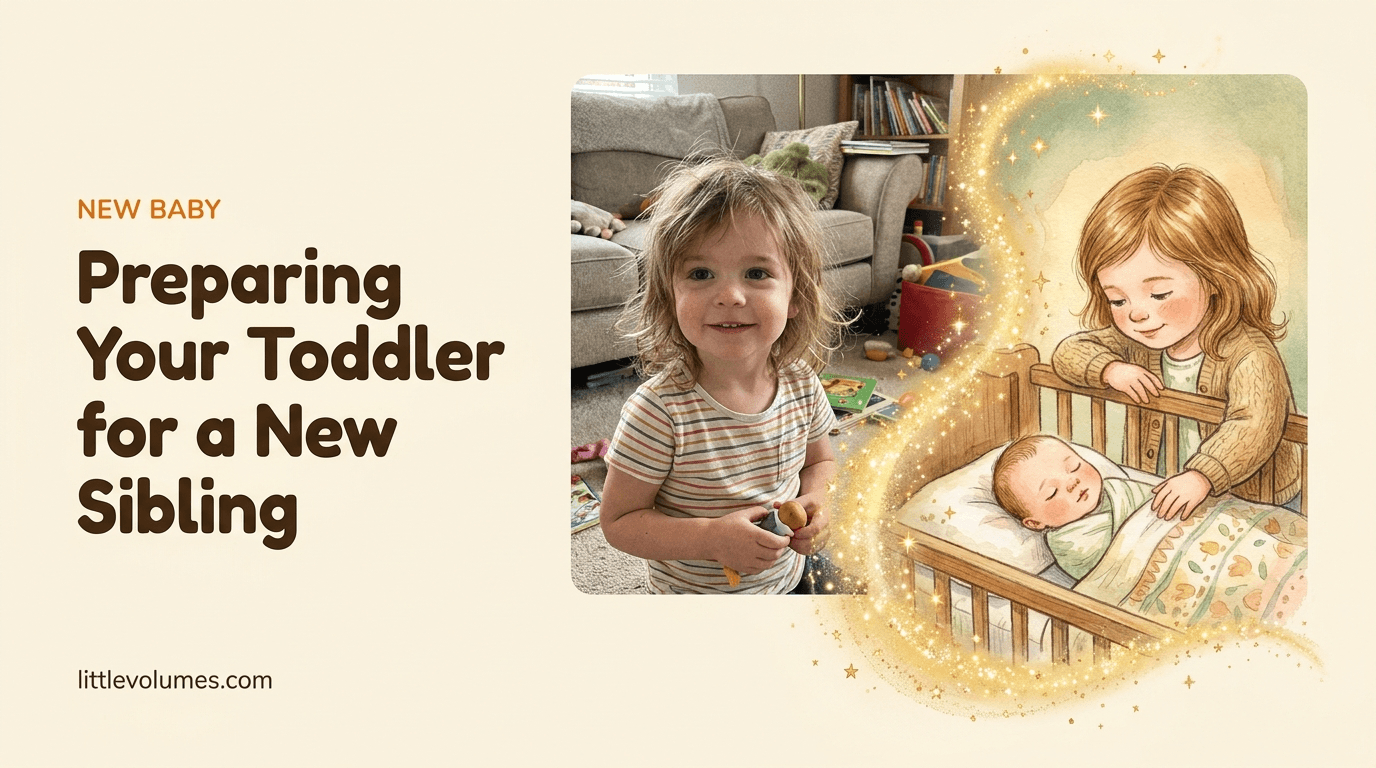
A generic new baby book shows your toddler that some child somewhere became a big sibling and it went fine. A personalized book shows them THEMSELVES, their face, their name, illustrated as the loving, capable, celebrated big sibling: helping, cuddling, showing the baby their world. For a toddler bracing against displacement, that is exactly the missing image. The story hands them a version of the future in which they are not replaced but promoted.
Read it through the pregnancy and it becomes rehearsal. Read it after the arrival and it becomes reassurance, on precisely the days reassurance runs low. And because the toddler is the star, it doubles as the answer to the classic hard moment when the baby's gifts arrive and the big sibling's hands are empty: this book is THEIRS, about THEM.
Our New Baby book is built for exactly this. Your toddler is illustrated from your photos as the hero and big sibling, with the new baby woven into their story rather than the other way round. Digital copy within 24 hours, printed keepsake available, and you can preview the first page free. Many families order it twice, once in pregnancy for the preparation months, and a printed copy for the hospital-day gift from the baby.
The takeaway
Your toddler is not wrong to sense that everything is about to change; it is. The work of the preparation months is to change the story they tell themselves about it: from something is being taken from me to I am becoming something more. Tell them early and casually, give them real jobs, keep their world steady, let the mixed feelings breathe, and put a book in their hands where the proud big sibling on every page has their own face. The baby will arrive either way. Whether a rival or a fan club president greets it is substantially up to the months before.
Make your toddler the hero of the new chapter: preview their big sibling book free, or browse the full catalog of personalized books.
Frequently asked questions
When should I tell my toddler about the new baby?
Around the second trimester works well for most families, once the pregnancy is visible enough to be real but with months left to adjust. Toddlers have a loose sense of time, so anchor the arrival to a season or event they know, when it gets cold, after your birthday, rather than a date.
How do I prepare my 2 year old for a new sibling?
Talk about the baby often and casually, read big sibling books together, let them feel kicks and help set up the nursery, practice gentle hands on a doll, and keep their routines as stable as possible. Frame changes as growing up perks rather than baby-driven losses.
Is regression normal when a new baby arrives?
Very. Many toddlers temporarily revert in sleep, potty habits, or wanting a bottle or dummy again. It is a bid for reassurance, not defiance. Meet it with warmth and patience, keep routines steady, and it typically fades within weeks as the child feels secure again.
How should the first meeting between siblings go?
Keep it calm and unhurried. If possible, have the baby in a cot rather than your arms when the toddler walks in, so your arms are free for them first. Let the toddler approach at their own pace, and consider a small gift from the baby to the big sibling.
How do I help my toddler bond with the new baby?
Give them a real role, fetching diapers, choosing the baby's outfit, singing to the baby, and narrate the baby's admiration, look how she watches you. Protect small pockets of one-on-one time with the toddler daily, even ten minutes, and avoid blaming the baby for waits and nos.
Do big sibling books actually help?
Yes. Stories let a toddler rehearse the change safely, name the mixed feelings as normal, and picture their new role positively. A personalized book where your own child is the proud big sibling in the illustrations works strongest of all, because they see themselves already succeeding at it.