First Day of School Books That Calm Big Nerves
August 8, 2026 · 7 min read · by LittleVolumes
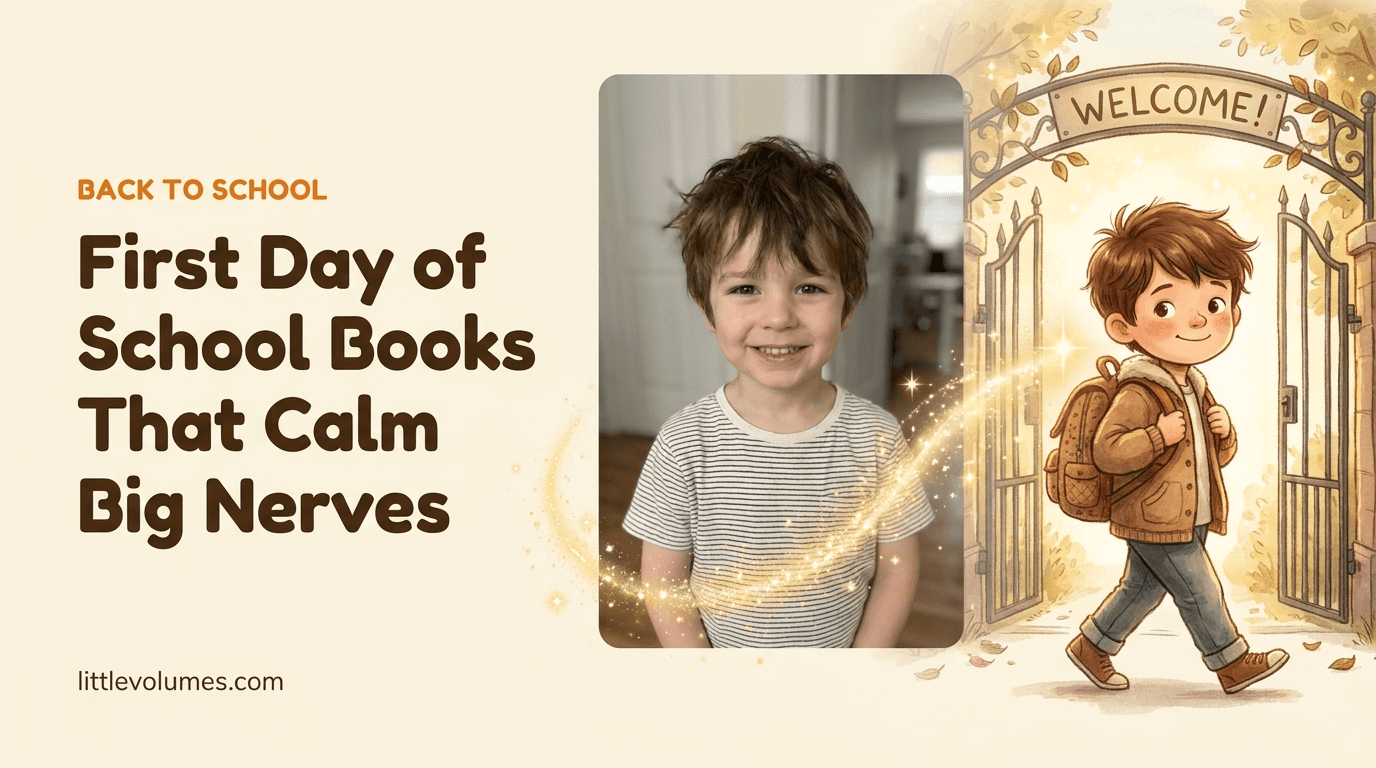
The best first day of school books help a nervous child feel brave, seen and ready. Here is how to choose one, when to start reading it, what to say on the morning itself, and why a personalized story works best of all.
Starting school is one of the biggest transitions in a small child's life, and the feelings that come with it are genuinely big: excitement, worry, curiosity and clinginess, sometimes all in the same hour. A good first day of school book gives your child a gentle way to understand what is about to happen, and gives you a shared language for the wobbly moments. This guide covers how these books work, how to choose one, exactly when and how to use it, and why a personalized version calms nerves faster than anything else on the shelf.
Why do first day of school books work so well?
Children make sense of the world through stories long before they can reason through it with logic. When a child hears about a character who feels nervous, packs a bag, says goodbye, meets a teacher and has a happy day, they get to live through the whole experience once before it actually happens. Child development experts call this rehearsal, and it is one of the most reliable ways to reduce fear of a new situation.
A story does three jobs at once:
- It names the worry out loud. Hearing "the child felt a little scared" tells your child that their feeling is normal and speakable, not something to hide.
- It makes the unknown known. The biggest driver of school nerves is simply not knowing what the day looks like. A story walks through the schedule: arrival, hanging up the bag, circle time, snack, play, pickup. Once the day has a shape, it stops being a void.
- It ends well. The character settles in, makes a friend, and gets collected at the end. That ending plants the most important belief of all: this turns out fine.
There is also a practical bonus for parents. Once you have read the book a few times, you share a reference. On a hard morning you can say "remember how it went in the story" and your child instantly has a whole reassuring narrative behind those few words.
When should you start reading a starting-school book?
Timing matters more than most parents realize.
| When | What to do | Why |
|---|---|---|
| 2 to 3 weeks before | Read the book for the first time, casually | Enough time to process, not enough to build dread |
| 1 week before | Re-read every few days, let questions come | Familiarity turns the story into comfort |
| The night before | One calm read at bedtime | Ends the day on a confident note |
| The first morning | One line, not the whole book | "Remember how brave you were in your story" |
Starting too early, months ahead, keeps school abstract and can stretch out low-level worry. Starting the night before gives big feelings nowhere to go. The sweet spot is one to two weeks, with repetition. Repetition is not boredom to a small child; it is safety. The third and fourth readings do more good than the first.
What should you look for in a first day of school book?
Not every school book helps a nervous child. Some are too long, some too silly to be reassuring, and some so cheerful they accidentally teach a child that worry is wrong. Look for these five things:
- A relatable main character who actually feels the nerves your child feels, not a character who bounces in delighted from page one.
- A clear, simple picture of the day from the goodbye at the gate to the pickup at the end. The pickup matters enormously: many children secretly worry most about whether you will come back.
- Honest feelings, honestly handled. The best books let the character feel scared AND brave. That is the emotional lesson: bravery is doing it while feeling wobbly.
- A warm, hopeful ending that shows the child settling in, not a punchline.
- The right length. For ages 2 to 6, that means a story you can read in five to ten minutes. An anxious child cannot absorb a saga.
Avoid books that tease ("you will be fine, silly!"), books where the parent sneaks away without saying goodbye, and books that spend most of their pages on the worry and only one page on the good day. The proportions teach as much as the words.
Why a personalized book calms nerves faster
Here is the difference a personalized book makes, and it is bigger than it first sounds. When the hero of the story is a stranger, your child watches someone else be brave. When the hero is your child, with their name on the cover and their face in every illustration, they watch themselves be brave.
Psychologists who study early childhood learning talk about identification: children learn most powerfully from models they see as similar to themselves. There is no model more similar to your child than your child. A personalized story removes the translation step entirely. Your child does not have to imagine that what happened to the book character could happen to them. It IS them, walking through the school gates, hanging up their own bag, waving at their own parent, having their own wonderful day.
Parents tell us the effect shows up in small, concrete ways: a child who asks for "my school book" every night for two weeks, a child who walks in on the first morning narrating their own story, a child who tells the teacher "I already did this in my book."
Our First Day of School book is built exactly for this. You share a few photos, we illustrate your child as the hero of a calm, warm first day, and the finished digital book arrives within 24 hours, with a printed keepsake available for the bookshelf. It becomes the rehearsal, the comfort object and the souvenir of a milestone, all in one.
What to say on the actual first morning
The book does the preparation, but the goodbye still has to happen. A few lines that work, drawn from what teachers consistently recommend:
- Name it: "It is okay to feel a bit wobbly. Lots of kids do."
- Express confidence: "You are so ready for this."
- Promise the reunion, specifically: "I will be at the gate right after story time."
- Connect to the book: "Just like in your story. And remember how that ended."
Then keep the goodbye short. Long, lingering goodbyes feel loving but actually signal to a child that there is something to be worried about. Warm, brief and confident is the kindest combination.
One more tip that teachers swear by: send them in with a job. "Will you tell me at pickup what snack was?" gives the day a friendly little mission and gives pickup a guaranteed conversation.
What if my child is still anxious after the first day?
Completely normal. For many children the second week is harder than the first, once the novelty wears off and they realize this is happening every day. Keep the book in the rotation, keep the goodbye ritual identical every morning, and keep your pickup promise sacred. Most settling-in wobbles resolve within two to four weeks. If distress is intense and not easing after a month, talk to the teacher, who has seen every version of this and will have practical ideas.
The takeaway
Starting school will always come with butterflies, and that is healthy. The right book will not delete every nerve, but it hands your child something to hold onto: a rehearsal of the day, proof that the feelings are normal, and an ending that turns out just fine. Make the hero of that story your own child, and the message lands as deeply as it possibly can: I have done this before, and I was brave.
Ready to make your child the hero of their own first day? Try it free and see the first page before you buy, or browse the full catalog of personalized books for every milestone.
Frequently asked questions
What is the best age to read first day of school books?
Between ages 2 and 6, when children start daycare, preschool or kindergarten. Reading the story in the week or two before the first day gives them time to picture the day and ask the questions on their mind.
Do first day of school books really help with separation anxiety?
Yes, as part of a bigger routine. Stories let a child rehearse a new experience safely. Seeing a character feel nervous and then have a good day teaches them that their own worry is normal and passes. Pair the book with a consistent goodbye ritual for the best results.
How do I prepare my child for the first day of kindergarten?
Visit the school beforehand if you can, practice the morning routine a few times, read first day of school books together in the two weeks before, keep the goodbye short and warm, and talk about the fun parts of the day rather than only the goodbye.
What makes a personalized first day of school book different?
A personalized book puts your child's name and face in the story, so they are the brave one walking through the school gates. Watching themselves succeed is far more reassuring than watching a stranger do it, and it gives you a shared reference point on the real morning.
What should I say to my child on the first morning of school?
Keep it short, confident and warm. Name the feeling, express confidence, and promise the reunion, for example "It is okay to feel wobbly. You are ready for this, and I will be at the gate when school finishes." Avoid long emotional goodbyes, which raise anxiety.
Are books better than just talking about the first day of school?
They work together. Talking answers your child's direct questions, but a story lets them process feelings at a comfortable distance and rehearse the whole day from start to finish, which pure conversation cannot do as vividly.