The Bedtime Routine That Actually Gets Toddlers to Sleep
August 16, 2026 · 6 min read · by LittleVolumes
Bedtime battles are not inevitable. Here is the evidence-backed toddler bedtime routine, how long it should take, why the story is the anchor step, how to handle stalling and curtain calls, and the bedtime book toddlers ask for on their own.
Somewhere between the third curtain call for water and the negotiation about one more show, most parents of toddlers conclude that bedtime is simply a battle age. It is not. Decades of pediatric sleep research point at one unglamorous hero: the consistent bedtime routine. Families who run one get measurably faster sleep onset, fewer night wakings, and calmer evenings, often within a week of starting. This guide lays out the routine that works, why the story slot is its anchor, and how to dissolve the classic stalling tactics without a fight.
Why does a bedtime routine work so well?
Toddlers do not tell time; they read sequences. A repeated chain of steps, bath, pajamas, teeth, story, song, lights, becomes a runway their body learns by heart. Each step predicts the next, arousal ratchets down link by link, and by the final step the child's system has already begun the descent into sleep. No single step does the magic. The predictability is the magic.
The research on this is unusually strong for parenting science: institution of a consistent bedtime routine improves sleep onset, reduces night wakings, and improves parent mood, with effects visible within days. And the benefits compound: children with steady routines at two sleep better at five.
The flip side explains the battles. An inconsistent bedtime is, to a toddler, an open negotiation. If the number of books varies by mood and the schedule by evening, every step becomes a debate worth having. Consistency is not rigidity for its own sake; it is the removal of everything there is to argue about.
The routine, step by step
The exact steps matter less than their order and repetition, but a well-tested template:
| Step | Time | Why it earns its place |
|---|---|---|
| Wind-down warning | 5 min before start | "After this puzzle, bath time" respects their agenda |
| Bath or wash | 5 to 10 min | Warm water plus the post-bath temperature drop cues sleepiness |
| Pajamas and teeth | 5 min | Same order nightly; offer tiny choices, which pajamas, to spend autonomy safely |
| Story time | 10 min | The anchor step; see below |
| Song or cuddle | 2 to 3 min | The final ritual, identical every night |
| Goodnight phrase and lights | 1 min | Same words nightly: the full stop at the end of the day |
Total: 20 to 30 minutes. Guard the boundaries at both ends. A routine that balloons past 45 minutes has usually absorbed stalling; one crammed into 10 feels abrupt and triggers resistance.
Two environment notes that punch above their weight: screens off for at least an hour before the routine starts, since evening screen light delays the sleep hormone melatonin and the content revs the brain you are trying to slow, and keep the last hour's play calm, puzzles and books rather than chasing games.
Why the story is the anchor step
Ask families with smooth bedtimes what the non-negotiable step is and the overwhelming answer is the story. It earns anchor status for three separate reasons:
- It is the wind-down. A calm story is ten minutes of stillness, closeness and a single quiet focus, exactly the neurological off-ramp a toddler cannot build alone.
- It is the lure. Children who fight pajamas will race through them when the story waits on the other side. The routine's most attractive step should sit near the end, pulling the whole chain along.
- It pays twice. Bedtime reading is one of the most consistent predictors of early language growth. The same ten minutes buying you a calm night is quietly building vocabulary.
What makes an ideal bedtime book: calm pacing, a warm ending, rhythm and familiarity. This is one place where a toddler's love of repetition is a feature, not a bug. The fortieth reading is soothing precisely because it holds zero surprises.
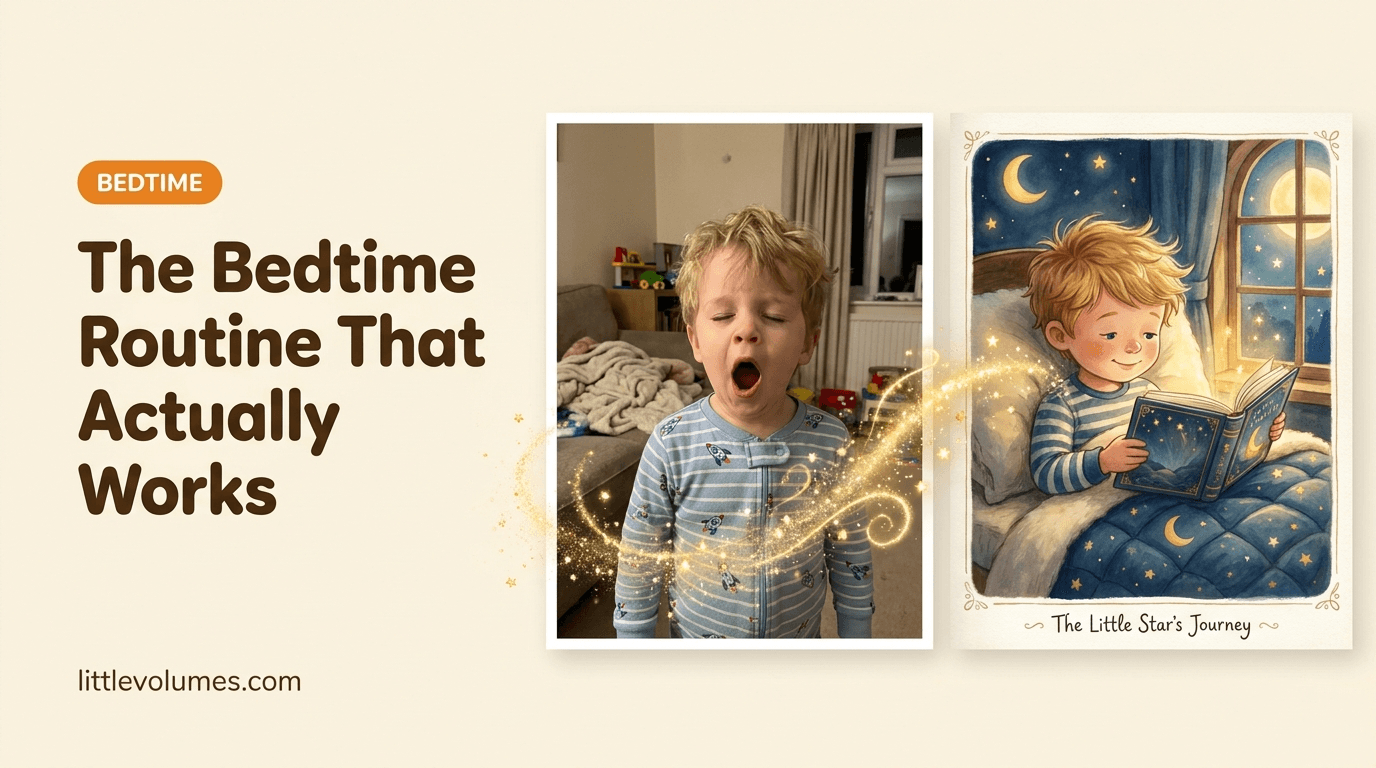
And there is one upgrade that makes the anchor step irresistible: a goodnight story where the child being tucked in on the page is your child. A personalized bedtime book puts your toddler's face and name into the ritual itself, they watch themselves wind down, cuddle up and fall asleep, safe and loved. Parents tell us it becomes the book the child asks for unprompted, which quietly flips bedtime's power dynamic: the child is now pulling toward the routine instead of being pushed through it. Our Goodnight book is built exactly for this slot, illustrated from your photos, calm from first page to last, with a free preview before you buy.
How to handle stalling, curtain calls and escapes
The classics, and the responses that work:
- "One more book." Decide the number, say it up front, "two books tonight, you pick them", and hold it warmly. The child who reliably gets two books stops litigating for five. A personalized book has a bonus here: it is usually the requested finale, and it is the same finale every night.
- "I need water. And the toilet. And..." Build the requests into the routine preemptively: water bottle by the bed, toilet as the pajama step. Needs that are pre-met stop working as delay tactics.
- The curtain calls. For repeated post-tuck-in appearances, the boring-return method is undefeated: walk them back calmly, minimal words, no scolding, no negotiation, every single time. The behavior extinguishes when it stops purchasing engagement. Expect a testing spike for two or three nights before it fades.
- Genuine fears. Monsters and dark-fear are developmentally real from around age two. Take them seriously without amplifying: a night light, a check under the bed done matter-of-factly once, and a story where nighttime is safe and cozy. Mockery makes fears bigger; calm acknowledgment shrinks them.
Through all of it, the tone that works is boring kindness. Bedtime drama, positive or negative, is engagement, and engagement is what a stalling toddler is shopping for.
When to adjust the schedule
If bedtime is a nightly wrestling match despite a consistent routine, the schedule is the next suspect. Counterintuitively, the most common culprit is a bedtime that is too LATE: an overtired toddler runs on stress hormones and fights sleep harder. Signs are evening hyperactivity, meltdowns at the routine's start, and taking ages to fall asleep after lights out. Try moving lights-out 20 to 30 minutes earlier for a week.
The opposite case appears near nap transitions, usually around age three: a child genuinely not tired at 7:30 because the afternoon nap is now too big for the day. Shortening or dropping the nap, while temporarily bracing for the 5 pm dip, often restores the evening.
The takeaway
Toddler bedtime is not won in the moment of resistance; it is won in the architecture. A 20 to 30 minute routine, same steps, same order, same words, converts bedtime from a nightly negotiation into a downhill path the child's own body knows by heart. Put the story at its center, make it a story they would choose themselves, ideally the one where the sleepy hero has their own face, and hold the edges with boring kindness. Most families see the change inside a week. The evenings you get back are yours to keep.
Make your child the hero of the goodnight story: preview it free, or browse the full catalog of personalized bedtime and milestone books.
Frequently asked questions
What is a good bedtime routine for a toddler?
A consistent 20 to 30 minute sequence in the same order every night, typically bath or wash, pajamas, teeth, one or two books, a song or cuddle, and lights out. Consistency of order and timing matters more than the specific steps. Research links regular routines to faster sleep onset, fewer night wakings and longer sleep.
What time should a toddler go to bed?
Most toddlers do best with lights out between 7 and 8 pm, aiming for 11 to 14 total hours of sleep including naps for ages 1 to 2, and 10 to 13 hours for ages 3 to 5. Watch your child rather than the clock: overtired evenings usually mean bedtime needs to move earlier, not later.
How long should a toddler bedtime routine take?
About 20 to 30 minutes. Shorter tends to feel abrupt and trigger resistance; much longer usually means stalling has been negotiated into the schedule. Decide the steps, keep the order identical, and let the routine itself signal that sleep is next.
Why does my toddler fight bedtime?
The usual suspects are separation feelings, fear of missing out, overtiredness, too much stimulation before bed, or an inconsistent routine that invites negotiation. A predictable sequence, an earlier bedtime, calmer last hour and a beloved final story fix the large majority of bedtime battles.
Does reading before bed help toddlers sleep?
Yes, on two fronts. The wind-down effect of a calm story lowers arousal before lights out, and the routine effect makes the story a reliable signal that sleep comes next. Reading before bed is also strongly linked to language growth, so the habit pays twice.
What makes a good bedtime story for a toddler?
Calm pacing, warm resolution, familiar rhythm, and ideally the child seeing themselves in it. Personalized goodnight books, where your child is the one being tucked in on the page, are especially effective as the anchor step, because children ask for them rather than resist them.